The next issue that looks to be lined up as part of the great secularist vs. religious debate is gay marriage. I've thought a lot about this over the last few days, and I've come to the view that it's not really an issue that has much to do with religion or secularism at all.
I'm sure that there will be those who portray the government's proposals as the latest step of those nasty militant secularists trampling all over their religious rights. The reality is that this is a bit about equality, a bit about democracy and quite a lot about politics, but it's not really about religion. Writing in the Telegraph this weekend, equalities minister Lynne Featherstone said that "this is not gay rights versus religious beliefs", and she's right.
Of course many religious people and groups are strongly opposed to gay marriage, just as many secularist and humanist groups are strongly in favour, and that's a good thing. Secularism isn't about opposing religion and all it stands for. One of it's principles is that everyone has the right to their own faith, and faith groups have the right to state and defend their views the same as everyone else.
I'll write that bit again, because it's important - the same as everyone else. No reasonable secularist would oppose the right of groups like the Coalition for Marriage to campaign against gay marriage, just as no reasonable churchgoer would have a problem with Stonewall supporting it. The only role I can see for secularism in this debate will come if the bishops in the house of lords use their privileged position to stop the legislation, but that's a debate for another day.
As for my own view by the way, I stood up in front of my friends and family (in a civil venue) and promised to love and support my wife for the rest of my life. I can see no reason why my gay friends shouldn't be able to do the same thing.
Monday, 27 February 2012


Friday, 24 February 2012
So what exactly are "Christian values" anyway?
One reason commonly given for Christianity to have a privileged place in the UK is that even if the number of those practising the faith is in decline, our country was founded on "Christian Values".
Fair enough, nobody can deny that Christianity has been the predominant faith in Britain for the last 1500 years or so, but is it really true that the values which underpin British society are Christian ones? What are Christian values anyway?
Not surprisingly, very few of those who pontificate on the subject define what they mean, but there are a few websites out there which provide lists of what they say are christian values (see here, here or here). Reading through those lists though, I don't think there's anything about the values they contain which is uniquely Christian. To illustrate what I mean, here are a small selection of them.
Fair enough, nobody can deny that Christianity has been the predominant faith in Britain for the last 1500 years or so, but is it really true that the values which underpin British society are Christian ones? What are Christian values anyway?
Not surprisingly, very few of those who pontificate on the subject define what they mean, but there are a few websites out there which provide lists of what they say are christian values (see here, here or here). Reading through those lists though, I don't think there's anything about the values they contain which is uniquely Christian. To illustrate what I mean, here are a small selection of them.
- Revering / loving / valuing God. OK, so on the face of it this is certainly a religious value, but is it really Christian? Do followers of any other religion not love or revere their god(s)? For that matter, atheists and humanists place great value on their own belief systems, whether or not they involve a deity. I don't think this can really be claimed as a "Christian value".
- Forgiveness. I don't claim to be an expert on comparative religion, but I can use Wikipedia, and it doesn't take long to discover that forgiveness is inherent in pretty much all cultures.
- Peace. Once again, peace is a fundamental part of all major faiths, particularly Islam. For that matter, I'm not religious, and I kind of like peace too!
I could go on, but it would only get boring. My point here, in case it wasn't clear, is that the values which underpin British society might be ones that Christians adhere to as part of their faith, but they are shared by people of all faiths and none.
I would say that Britain (and most other countries) is founded on human values, not Christian ones and with that we come back to the fundamental point of secularism. However important our own beliefs are to us individually, the state should approach and respect us all equally as humans.
Wednesday, 22 February 2012
Calm down dear - the Bishop of Leicester goes off on one!

The Right Reverend Tim Stevens, Bishop of Leicester, wrote this extraordinary article in the Leicester Mercury this week attacking secularism. Wondering what a secular society might look like, he asks :
If there were no public prayers said before any Government proceedings, if there were no great services in our cathedrals, and if there was no monarch to act as head of the Established Church, would our lives be more free and fulfilled? What if the spires and towers of our parish churches were removed from our cityscapes and landscape? What if every village no longer had an ancient iconic building at its heart? What if the mosques, temples and gurdwaras were removed from Leicester?
Hang on a minute! Nobody is suggesting that prayers shouldn't be said before government proceedings for those who want them, only that those who don't want to worship shouldn't be at a disadvantage. Who has ever said that there shouldn't be services in our cathedrals? A central tenet of secularism is that everyone should be free to worship in their own way, or not at all as they see fit. As for there being no monarch, while most secularists would welcome the disestablishment of the C of E, I think regicide might be taking things a bit too far!
The second part of his piece, where he seems to suggest that secularists want all religious buildings razed to the ground, is really so ridiculous that any comment from me seems unnecessary.
All in all, this is the kind of vicious scaremongering that you might expect from an unreformed Daily Mail columnist, but you might hope a Bishop would know better. Thankfully, I suspect that the good people of Leicester are not stupid enough to fall for it. I would advise Bishop Tim to take a deep breath, have a cup of tea, and go and read the NSS website to find out what secularism is really about.
"Moral complicity" - think about it
In the aftermath of the Bulls guest house case (see my previous post), Christian barrister Neil Addison posted this blog setting out his frustration that, in his words, the courts are unable to recognise the "nuance" of moral complicity which sits behind the case.
In his words, this means :
"... the fact that giving a double room to an unmarried couple would make the Bulls morally complicit in an immoral act. Were they, for example, running a restaurant and had refused to give a meal to a same sex couple then that would have been simple discrimination but their stand was more nuanced than that ..."
He seems to be saying that discrimination is generally a bad thing, but it's OK if the alternative is to be an accessory to something that you consider to be morally wrong. Fair enough, yes?
Well actually, no. If we agree that it is OK to discriminate in order to avoid moral complicity, then who is to decide what is or isn't moral? The Bulls acted as they did because they believe that gay sex is immoral, so should we all just accept that their behaviour was reasonable? What if I thought that it was immoral for black people to sit at the front of a bus? Would that make it OK for me to stop Rosa Parkes from taking her seat?
The point here of course is that we all have our own moral code, and with over 60 million of us in the UK, we're not all going to agree on what is or isn't morally right. That's why we have a democratically elected parliament to make laws on our behalf, and those laws must apply to us all, whether we like them or not.
Tuesday, 21 February 2012
Gay rights DON'T trump religious ones!
Since the Bulls (the Christian couple who refused to allow a gay couple to stay at their guest house) lost their appeal last week, there has been a fresh round of complaints by the usual suspects that gay rights have been held up over religious ones, feeding the ongoing narrative about an "attack on religion".
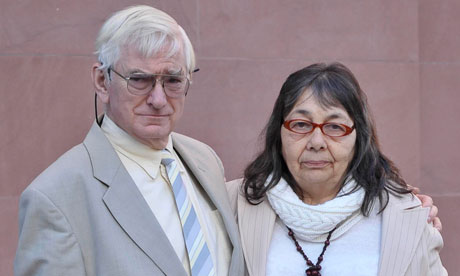 The reality, as ever, is different. The law in question here is the Equality Act 2010. It doesn't place one set of freedoms or rights as more important than another, it simply says that it is illegal to discriminate on various grounds, including sexuality, and religion.
The law is actually one-sided here, but not in favour of gay people, or against the religious. The act places a duty not to discriminate on those who offer a service to the public, but places no such duty on the public themselves. In other words, guests can choose which hotel they want to stay at, but hotels cannot choose their guests (well, not based on their sexuality or their religion anyway).
What that means is that if a gay hotel owner had turned the Bulls away because they are Christians, the hotel owners would have been just as guilty of discrimination as the Bulls were found to be. The law applies equally to all of us, and that's exactly what secularism is all about.
Monday, 20 February 2012
Ending council prayer isn't an attack on anybody
In my working life, I attend a lot of meetings. Some of these are optional, but most are an integral part of my job. I'd consider it more than a little odd, not to mention inappropriate, if the person chairing one of those meetings announced that they'd invited the local vicar / rabbi / imam along to lead us all in prayer. I suspect that the same would apply to most of you. Unless you happen to work in a place of worship, prayer is not a required part of most peoples' working environments, nor should it be.
If you believe all the hype and hysteria that has spewed forth since last week's high court ruling on council prayers in Bideford, it was all about "atheist councillor Clive Bone" seeking to impose his atheism on everybody else. In fact, of course, it's entirely the opposite.
Throughout the case, nobody has suggested that councillors shouldn't be able to pray before going to a meeting, or even pray silently during it. The case merely suggested that worship should not be part of a council's formal business, and should not be required of councillors in order to do their democratic duty. In other words, nobody is saying that councillors shouldn't be religious, only that the council shouldn't be. That seems like a reasonable request to me.
"Hang on though," supporters of council prayer will say, "prayer is part of our nation's heritage." Bideford Council has apparently been praying during meetings for 200 years. Back when they started, that was fair enough - it would have been unthinkable that anyone who wasn't a Christian would ever sit on the council. It would also have been unthinkable, by the way, that anyone who wasn't white and male would sit on the council. Those days are thankfully gone, and our public institutions need to adapt their behaviour accordingly.
If you believe all the hype and hysteria that has spewed forth since last week's high court ruling on council prayers in Bideford, it was all about "atheist councillor Clive Bone" seeking to impose his atheism on everybody else. In fact, of course, it's entirely the opposite.
Throughout the case, nobody has suggested that councillors shouldn't be able to pray before going to a meeting, or even pray silently during it. The case merely suggested that worship should not be part of a council's formal business, and should not be required of councillors in order to do their democratic duty. In other words, nobody is saying that councillors shouldn't be religious, only that the council shouldn't be. That seems like a reasonable request to me.
"Hang on though," supporters of council prayer will say, "prayer is part of our nation's heritage." Bideford Council has apparently been praying during meetings for 200 years. Back when they started, that was fair enough - it would have been unthinkable that anyone who wasn't a Christian would ever sit on the council. It would also have been unthinkable, by the way, that anyone who wasn't white and male would sit on the council. Those days are thankfully gone, and our public institutions need to adapt their behaviour accordingly.
Sunday, 19 February 2012
Welcome
Welcome to my new blog. As I start this in February 2012, the UK is in the middle of a storm of media attention on the role of religion in the state. This was triggered just over a week ago by two high-profile legal cases, the banning of council prayers at Bideford, and the unsuccessful appeal by christian guest house owners against their conviction for barring a gay couple from their hotel.
Since then, I have seen various people reaching for the nearest microphone and decrying secularists as "militant", "illiberal", "chilling", "wanting to impose their minority view on society" and so on. I've found myself shouting at the TV more than once, so I decided to come here and try to do something about it.
The aim of this blog is to counter the attempts to portray secularism as some kind of dark force intent on destroying British customs and values. I'll try to do that by putting over the reasonable and reasoned argument for secularism as calmly and cogently as I can.
The first few posts that you'll see have been written pretty much back to back, they're my reaction to a few issues that have cropped up over the last week or so. After that, the idea is that as stories or comment on secularist issues hit the press, I'll come here and post my response. I've got no idea how long this will last, whether anyone will read it, or if it will change anybody's mind, but here goes.
Since then, I have seen various people reaching for the nearest microphone and decrying secularists as "militant", "illiberal", "chilling", "wanting to impose their minority view on society" and so on. I've found myself shouting at the TV more than once, so I decided to come here and try to do something about it.
The aim of this blog is to counter the attempts to portray secularism as some kind of dark force intent on destroying British customs and values. I'll try to do that by putting over the reasonable and reasoned argument for secularism as calmly and cogently as I can.
The first few posts that you'll see have been written pretty much back to back, they're my reaction to a few issues that have cropped up over the last week or so. After that, the idea is that as stories or comment on secularist issues hit the press, I'll come here and post my response. I've got no idea how long this will last, whether anyone will read it, or if it will change anybody's mind, but here goes.
Subscribe to:
Comments (Atom)